

Tel Aviv is one of the most fascinating cities in the world for architectural photography. The White City, designated a UNESCO World Heritage Site in 2003, contains thousands of buildings constructed mainly from the 1930s through the 1950s, reflecting the development of modern architecture in the city. But photographing Tel Aviv's Bauhaus architecture in an interesting way is about more than finding a white building and photographing it straight on.
The real magic is in the details: curved balconies, horizontal windows, pilotis, light and shadow, staircases, clean façade lines, and the way each building interacts with the street.
For me, good architectural photography isn't simply about documenting a building. It's about understanding how architecture meets light, the street, and everyday life in Tel Aviv.

Old & New Tel Avivian Architecture
What Makes a Tel Aviv Building "Bauhaus"?
One of the most interesting things about Tel Aviv's architecture is that the style wasn't simply copied from Europe. Architects who came to Tel Aviv adapted modernist ideas to the city's local climate and way of life.
When photographing these buildings, look for:
-
Deep, shaded balconies
-
Strong horizontal lines
-
Ribbon windows
-
Rounded corners
-
Flat roofs
-
Pilotis and raised ground floors
-
Light-colored façades
-
Windows and architectural elements designed for shade
-
Relatively simple compositions without excessive decoration
Tel Aviv's International Style architecture was adapted to the Mediterranean climate, making elements such as shade, ventilation, balconies, and horizontal forms particularly important.

Shading Elements at the Staircase
Where to Photograph Bauhaus Architecture in Tel Aviv
Rothschild Boulevard
This is where I would start. The boulevard and surrounding streets offer a large concentration of modernist buildings, allowing you to photograph many different examples within a relatively small area. But don't limit yourself to photographing buildings from directly in front. Look for street corners. When two sides of a building meet at a corner, balconies, horizontal lines, and curves can create a much more interesting composition than a flat frontal view.
Photography tip:
Stand across the street and use a relatively wide-angle lens. Try leaving some sky above the building so the architecture doesn't feel cramped inside the frame.


Bauhaus Buildings in Rothschild Blvd.
Dizengoff Square
Dizengoff Square is a great place to understand how architecture works as part of an urban environment rather than as an isolated object. The curved buildings surrounding the square create almost graphic compositions, especially when photographed from an angle that emphasizes their curves. Try visiting when the sun creates strong shadows across the façades.


Baushaus Buildings around Dizengoff Square
Bialik Street and the Surrounding Area
The Bialik area is particularly interesting because it shows the meeting point between different periods of Tel Aviv architecture. Within a few minutes, you can move from earlier eclectic architecture to modernist buildings.
This is a great place for a photography exercise:
Don't just look for a beautiful building. Look for contrast.
An old building next to a new one. A decorated façade beside a minimalist one. A tree against concrete. Deep shadow against a white wall. These contrasts can turn architectural photography into something much more interesting than simply photographing a beautiful building.

A Rounded Balcony in Bialik Street
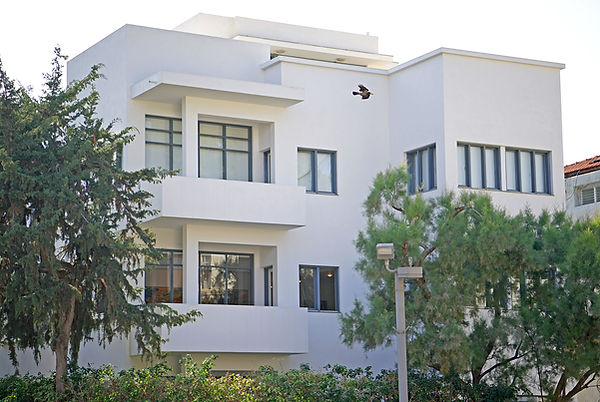
Bauhaus Building in Bialik Street
Lev Ha'ir and the Side Streets
One common mistake is to stay only on the main streets.
The side streets can actually be more interesting for photography.
Here you may find:
Original balconies | Old shutters | Staircases | Entrance doors | Windows | House numbers | Tiles
All of these can become subjects in their own right.


Bauhaus Architecture in Lev Ha'ir Area
Don't Just Photograph the Building — Photograph the Details
This may be the most important tip in this guide.
If you spend an hour photographing Bauhaus architecture, don't create ten photographs that all look almost identical.
Instead, try creating a series:
1. Wide shot — the building and the street
2. Medium shot — the balconies or façade
3. Close-up — a window, railing, or architectural detail
4. Abstract shot — lines, shapes, and shadows
Suddenly, one building can become four completely different photographs.

Finding Depth of Field While Capturing Bauhaus Architecture
Look for Shadows
The light in Tel Aviv is part of the architecture.
Deep balconies, columns, railings, and windows create patterns of light and shadow that change throughout the day. When the sun is relatively low, shadows can become the central element of the composition.
Instead of thinking: "I'm photographing a white building." Think: "I'm photographing the shadow created by the building." That shift in perspective can turn an ordinary architectural photograph into an artistic image.

Shadows Created by the Balconies
Black and White Photography
Modernist architecture works particularly well in black and white.
When color is removed, the eye begins to focus on:
-
Shapes | Lines | Textures | Geometry | Light | Shadow | Proportions
So if the colors of the street are distracting attention from the architecture, try photographing the building again in black and white. This approach also works beautifully with a collection of Black & White Tel Aviv Photography.

Black & White with Bauhaus Architecture
When Is the Best Time to Photograph?
Morning:
Cleaner light, quieter streets, and fewer people.
Midday:
Hard shadows and strong contrast. Excellent for graphic and architectural photography.
Afternoon:
The light becomes softer and façades gain more depth.
Golden hour:
Ideal when you want to combine architecture with warm light and atmosphere.
But there isn't one "correct" time to photograph.
If you're looking for shapes and geometry, hard midday light can work extremely well.
Which Lens Should You Use?
For street and architectural photography in Tel Aviv, I like working with several different focal lengths.
Wide-angle lens — for photographing an entire building and its surroundings.
Standard lens — useful when you want a more natural perspective.
Telephoto lens — excellent for architectural details and photographing façades from a distance.
And most importantly: don't feel that you have to fit the entire building into the frame.
Sometimes one quarter of a building makes a much better photograph than the entire building.
Watch Out for Distortion
When photographing a tall building with a wide-angle lens and tilting the camera upward, vertical lines begin to converge. Sometimes this looks great. But if your goal is a clean and precise architectural photograph, try to keep the camera as level as possible. You can also correct perspective later in editing software.

Parallel Lines

A Wide Angle Lens to Capture the Whole Building
Look for Tel Aviv Within the Bauhaus
This is perhaps the most important part of the guide for me. Tel Aviv's architecture isn't simply a copy of European architecture. It was adapted to the local climate and way of life. The result is a modernist architectural language that became distinctly Tel Avivian. So when you photograph these buildings, look for the things that make them Tel Aviv:
Balconies designed for shade. Windows that let in light while protecting against the sun. Trees growing around the building. Bicycles locked to a pole. Laundry hanging from a balcony. An air-conditioning unit added decades later. A street sign. A scooter parked beneath the building. These are the details that tell the story of the city.


Trees Covering Bauhaus Balconies
Liebling House — A Good Place to Start
If you want to go deeper than simply photographing buildings from the street, Liebling House – The White City Center is an excellent place to begin. Located at 29 Idelson Street, the building was designed in 1936 by architect Dov Karmi and engineer Zvi Barak and is itself an example of International Style architecture.
The center focuses on architecture, conservation, and Tel Aviv's White City. It's a great place to develop an understanding of the architectural language before heading out to photograph it in the streets.

Liebling House - 29 Idelson Street
A Photography Exercise: One Building, Five Photographs
The next time you come across an interesting Bauhaus building, don't simply take one photograph and move on.Stop for 15 minutes.Photograph:The entire buildingThe building from the cornerOne architectural detailA play of light and shadowThe building as part of the streetAt the end, try to choose only one photograph.It's a simple exercise, but it can teach you much more about architectural photography than simply searching for the most beautiful buildings.
Photographing Bauhaus as Fine Art
Ultimately, my goal isn't to create a catalogue of Bauhaus buildings in Tel Aviv.I'm looking for the moment when architecture, light, and the city come together in a single photograph.Sometimes it's an entire building.Sometimes it's a balcony.Sometimes it's just a shadow on a white wall.And very often, these small details tell the best story of all about the White City.

